
maj 21, 2026
The five most important safety rules for mini excavator operation are: 1) Always wear your seatbelt – the ROPS only protects you if you’re inside it; 2) Perform a daily inspection – catch problems before they cause accidents; 3) Keep bystanders away – no one within the swing radius; 4) Stay clear of overhead power lines – maintain at least 10 feet distance; 5) Operate on stable ground – avoid steep slopes and soft edges. Most excavator accidents are preventable with proper training and awareness.
Key fact: OSHA reports that the majority of excavator‑related fatalities involve tip‑overs or contact with overhead power lines – both largely preventable with proper precautions. 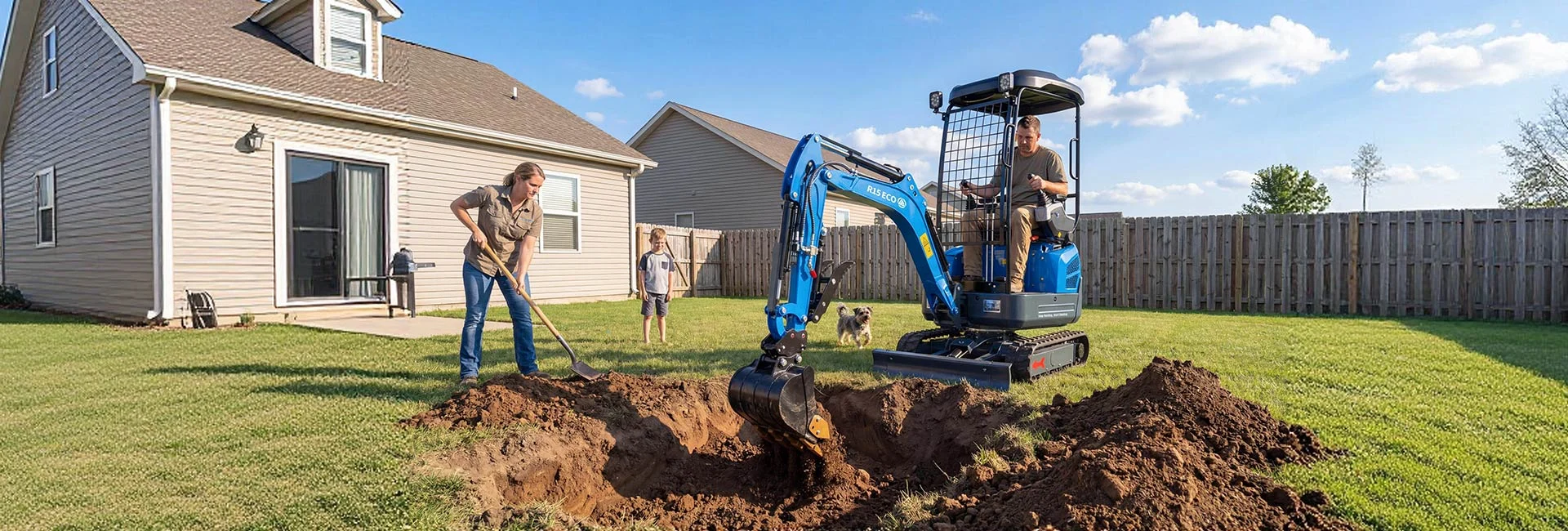
A thorough daily inspection takes 5‑10 minutes and can prevent accidents. Do this before starting the engine every day.
Visual walk‑around:
Fluid leaks: Look under the machine for puddles (hydraulic oil, engine oil, coolant, fuel)
Hoses: Check for abrasion, bulges, or loose fittings – a burst hose can injure the operator
Tracks: Inspect for cuts, embedded debris, proper tension (10‑15 mm sag)
Bucket/attachment: Check for cracks, especially at weld points, missing teeth
Structure: Scan boom, arm, and frame for new cracks or damage
Safety devices: Test horn, lights, backup alarm, seatbelt
Fluid checks:
Engine oil, hydraulic oil, coolant, fuel – all at proper levels
Never run low on hydraulic oil – pumps fail instantly and can cause sudden loss of control
Function test: Run all controls through full range before starting work. Check for hesitation, drift, or unusual noise.
Always wear:
Hard hat – Protects from falling debris
Safety glasses – Shields from dust and flying particles
Hearing protection – Excavators are loud (85‑100 dB)
High‑visibility vest – Especially when working near others
Steel‑toed boots – Protects feet from heavy objects
Gloves – Better grip, protects hands
Seatbelt – Essential – wear it at all times, even for small moves
The seatbelt is not optional. The ROPS (Roll‑Over Protective Structure) can only protect you if you are inside it with the seatbelt fastened. If you are thrown out during a tip‑over, the ROPS does nothing.
Entering and exiting:
Use three points of contact (both hands and one foot, or both feet and one hand)
Never jump – always climb carefully
Keep steps and handholds clean and dry
Face the machine when climbing
Starting the engine:
Ensure all controls are in neutral
Sound horn before starting to alert anyone nearby
Let engine warm up at low RPM for 3‑5 minutes
Check all gauges and warning lights
Operating:
Keep bucket low to ground when traveling (4‑6 inches clearance)
Travel with boom centered and bucket carried low for stability
Never exceed the machine’s rated lift capacity
Avoid sudden movements – smooth operation is safer operation
Always look in the direction of travel – use mirrors for rear visibility
Stopping and parking:
Park on level ground
Lower bucket to the ground
Reduce engine RPM to idle for 2‑3 minutes
Turn off engine and remove key
Set parking brake
Never leave machine running unattended

Contact with power lines is one of the leading causes of excavator fatalities.
Minimum safe distances:
Up to 50 kV: 10 feet
50‑200 kV: 15 feet
200‑350 kV: 20 feet
350‑500 kV: 25 feet
500‑750 kV: 35 feet
If you must work near power lines:
Call the utility company before starting work – they may de‑energize lines or install protective covers
Use a spotter to maintain safe distance
Consider using a proximity alarm system
Never assume lines are insulated – most are not
If you contact a power line:
Stay in the machine – do not exit
The ground around the machine may be energized
Warn others to stay away
Wait for the utility company to de‑energize the line
Only exit if the machine is on fire – and if you must exit, jump clear without touching the machine and ground simultaneously
Mini excavators have a high center of gravity – slope operation requires extra caution.
| Slope | Risk Level | Recommended Action |
|---|---|---|
| Under 10° (5.7:1) | Niski | Normal operation with care |
| 10‑15° (5.7:1 to 3.7:1) | Umiarkowane | Travel up/down, not across |
| 15‑20° (3.7:1 to 2.7:1) | Wysoki | Avoid if possible, use extreme caution |
| Over 20° (2.7:1) | Extreme | Do not operate |
Safe slope operation guidelines:
Travel straight up and down slopes – never across
Keep the heavy end (engine) uphill when possible
Keep bucket low to ground (4‑6 inches)
Avoid sudden turns or direction changes
If the machine feels unstable, stop and reposition
Use wide track position for maximum stability
If the machine starts to tip: Do not jump out. Stay belted, lean uphill, and do not try to exit until the machine settles. Tipping is rare on level ground – avoid steep slopes.
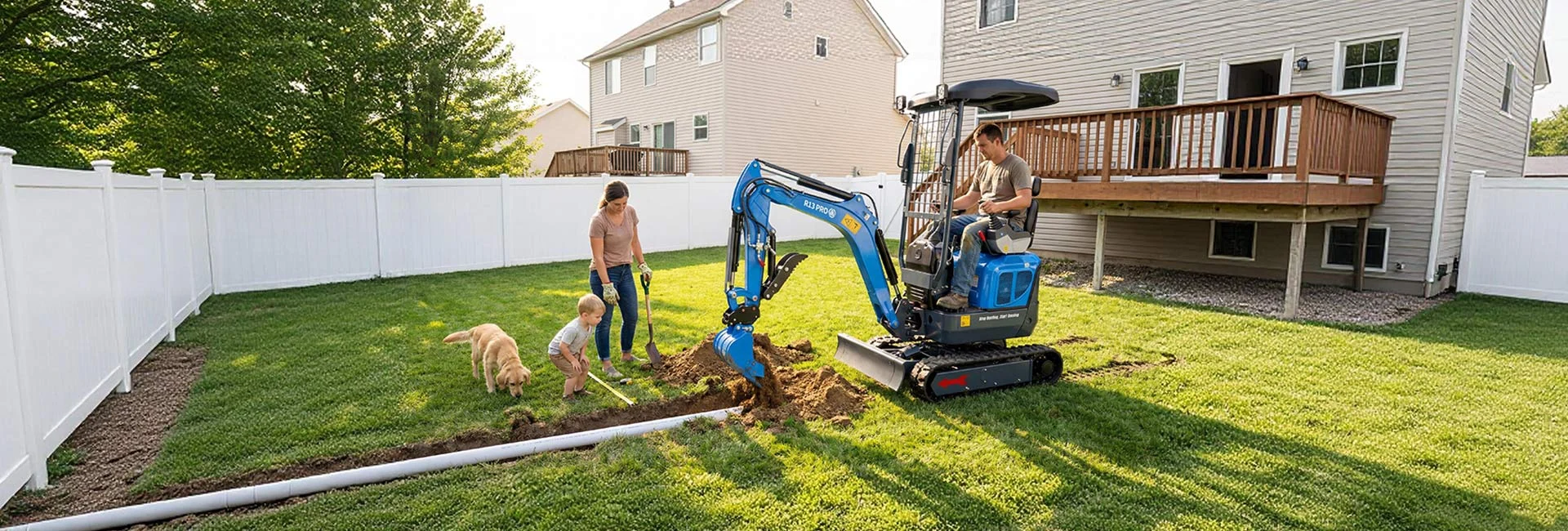
Trench and edge work requires special precautions.
Safety guidelines:
Keep machine at least 2‑3 feet away from excavation edges
Use a spotter when working near edges
Ensure ground is stable and can support machine weight
Never work under an unsupported overhang
For trenches over 4 feet deep, use trench boxes or slope the walls
Spoil pile placement:
Place excavated material at least 2 feet from trench edge
Keep spoils low enough to maintain visibility
Never place spoils where they could roll back into the trench
Most excavator accidents involving bystanders occur within the machine’s swing radius.
Safety rules:
Establish a safety zone – no one within the swing radius
Use spotters when working near people
Sound horn before swinging or moving
Use backup alarm (should be standard equipment)
Never allow riders on the machine
Keep children and pets away from work area
If you lose sight of a spotter: Stop immediately. Sound horn. Wait for spotter to reappear before continuing.
When using the excavator to lift materials, follow these rules:
Before lifting:
Verify lift capacity – do not exceed rated capacity
Use certified lifting slings and hardware
Inspect all rigging before use
Ensure load is balanced
During lifting:
Lift slowly and smoothly
Keep load close to ground when traveling
Never swing load over people
Use tag lines to control load rotation
Never:
Use bucket teeth as a lifting hook
Exceed machine’s rated lift capacity
Lift people with the bucket (use a certified man basket only)
Machine fire:
Shut off engine immediately
Exit machine
Use fire extinguisher if safe to do so
Call emergency services
Hydraulic hose burst:
Stop all functions immediately
Shut off engine
Do not attempt to operate – fluid under pressure can inject through skin
Have a qualified technician repair
Machine stuck or tipped:
Do not attempt to self‑recover if tipped – wait for professional recovery
If stuck, assess situation before attempting recovery
Use proper recovery equipment – never use chain or strap that could snap

Q: Do I need a license to operate a mini excavator on my own property?
A: No. For personal use on your own land, no license or certification is required. For commercial work, OSHA requires operator training and certification.
Q: Can my teenager operate the excavator?
A: Only with proper training and constant supervision. Age isn’t the issue – maturity and responsibility are. Many teens learn faster than adults.
Q: What should I do if I hit an underground utility?
A: Stop immediately. Notify the utility company. Do not try to cover it up or continue working. Call 811 to report.
Q: How often should I replace the seatbelt?
A: Inspect seatbelt daily. Replace if frayed, cut, or if the buckle doesn’t latch securely. Seatbelts are cheap – your life isn’t.
Q: What’s the single most important safety rule?
A: Wear your seatbelt. Always. Every time. Even for small moves. The ROPS only works if you’re inside it.
Operating a minikoparka is safe when you follow the rules. The key is consistency – perform your daily inspection, wear your PPE, keep bystanders away, and never get complacent. Most accidents happen when operators skip the basics because “it’s just a small job.” Every job deserves the same safety attention.
Next step: Review your operator’s manual. Post safety rules in your shop. And always – always – wear your seatbelt.


 Strona główna
 Produkty
 E-mail
 WhatsApp