
мар 05, 2026
[newsletter_form]For equipment buyers, the purchase price represents only the beginning of the financial commitment. Total Cost of Ownership (TCO)—including fuel, maintenance, repairs, downtime, and resale value—often exceeds the initial investment by a significant margin over the machine’s life.
This analysis examines the TCO components for mini excavators in the 1-3 ton class, using real-world data from owner surveys, maintenance records, and industry studies. The information presented here will help buyers evaluate options based on long-term economics rather than upfront price alone.
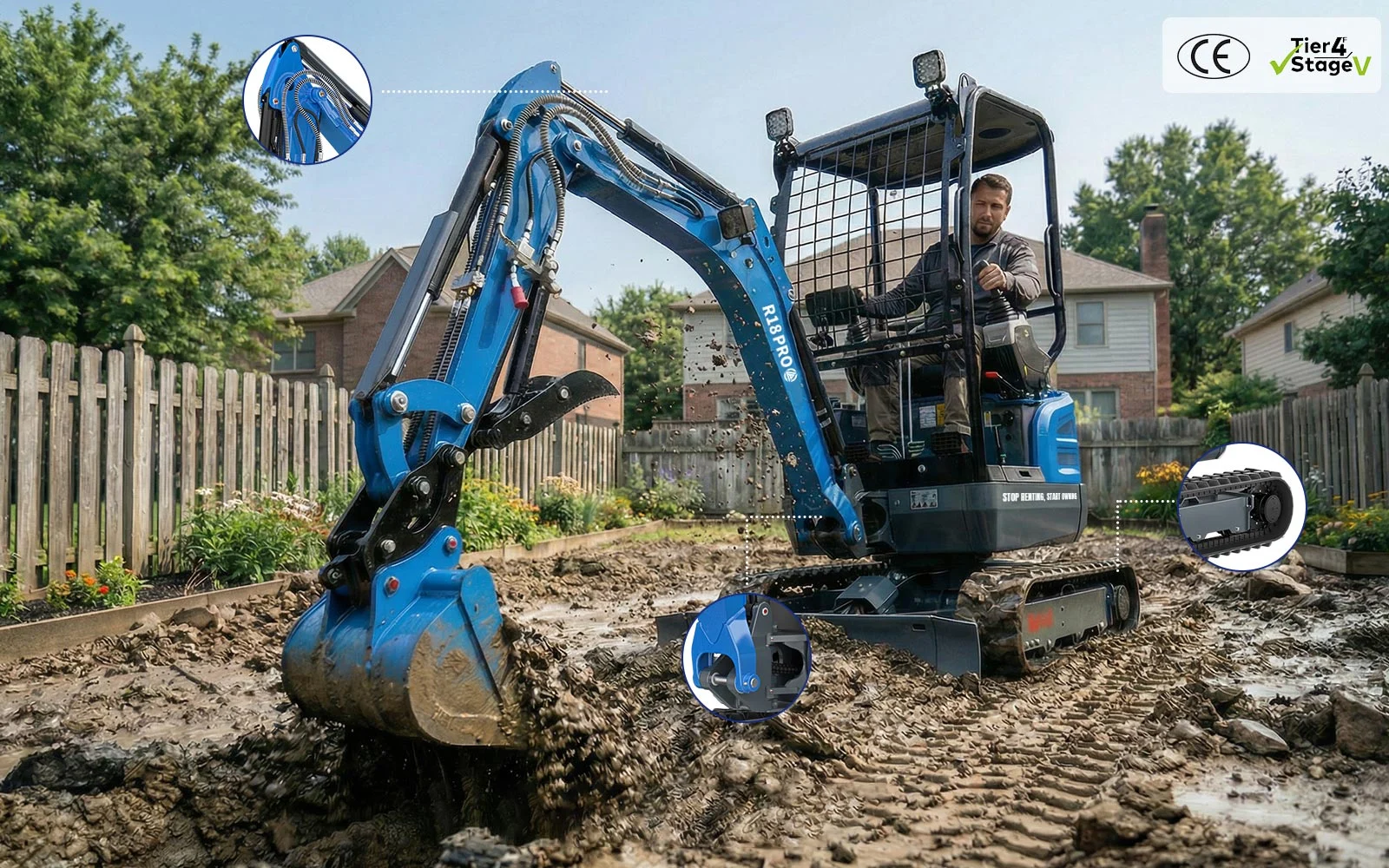
The initial purchase price varies significantly based on brand, size, features, and geographic market. For mini excavators in the 1.5-ton class (the most popular segment), typical pricing ranges are:
| Brand Category | Price Range (USD) | Notes |
|---|---|---|
| Premium (Kubota, CAT, Bobcat) | $35,000–$45,000 | Established dealer networks, high resale |
| Mid-Tier (Korean, European) | $28,000–$38,000 | Good quality, moderate resale |
| Value (RIPPA, Chinese brands) | $22,000–$32,000 | Comparable specs, longer warranty |
Key insight: While premium brands command higher prices, the differential is often 30-50% compared to value brands. This gap must be justified by lower operating costs or higher resale value to make financial sense.
Fuel represents one of the largest ongoing costs for diesel-powered excavators. Actual consumption varies based on load, operating conditions, and operator technique.
Average fuel consumption by machine size:
| Machine Size | Typical Consumption | Annual Cost (1,000 hours) |
|---|---|---|
| 1.0–1.5 ton | 1.0–1.5 L/h | $1,200–$1,800 |
| 1.5–2.5 ton | 1.5–2.5 L/h | $1,800–$3,000 |
| 2.5–4.0 ton | 2.5–4.0 L/h | $3,000–$4,800 |
| 4.0+ ton | 4.0–6.0 L/h | $4,800–$7,200 |
*Assumes diesel at $1.20/L (approximate US average for off-road diesel)*
Fuel efficiency technologies:
Modern excavators incorporate several technologies to reduce fuel consumption:
| Technology | Typical Savings |
|---|---|
| Load-sensing hydraulics | 10–15% |
| Auto-idle / auto-shutdown | 5–10% |
| Variable displacement pumps | 10–20% |
| Efficient engine mapping | 5–8% |
According to RIPPA test data, their load-sensing hydraulic system combined with efficient Kubota engines achieves up to 20% fuel savings compared to conventional designs .
Regular maintenance is essential for reliability and longevity. Costs vary based on machine size, usage intensity, and local labor rates.
Typical annual maintenance costs (500 operating hours):
| Component | DIY Cost | Dealer Cost |
|---|---|---|
| Engine oil changes (2x) | $100–$150 | $300–$450 |
| Hydraulic oil change (annual) | $150–$250 | $400–$600 |
| Filters (air, fuel, hydraulic) | $100–$200 | $250–$400 |
| Grease and miscellaneous | $50–$100 | $100–$200 |
| Track tension/adjustment | $0–$50 | $100–$200 |
| Total annual | $400–$750 | $1,150–$1,850 |
Long-term maintenance intervals:
| Component | Interval | Typical Cost |
|---|---|---|
| Hydraulic system flush | 2,000 hours | $800–$1,500 |
| Track replacement | 1,500–2,500 hours | $1,500–$3,000 |
| Final drive service | 2,000 hours | $500–$1,000 |
| Engine overhaul | 6,000–8,000 hours | $3,000–$6,000 |
Unplanned repairs represent the most variable and potentially largest cost component. Machine quality, operating conditions, and maintenance practices all influence repair frequency and expense.
Common repair items and costs:
| Repair | Typical Cost | Typical Interval |
|---|---|---|
| Hydraulic hose replacement | $150–$400 | 1,000–2,000 hours |
| Track adjuster seal | $200–$500 | 1,500–3,000 hours |
| Swing bearing replacement | $2,000–$4,000 | 4,000–6,000 hours |
| Hydraulic pump rebuild | $2,500–$5,000 | 4,000–6,000 hours |
| Cylinder reseal | $500–$1,500 | 2,000–4,000 hours |
Warranty impact:
A comprehensive warranty significantly reduces financial risk during the ownership period. RIPPA’s 5-year/5,000-hour warranty covers most major components during the period when failures are most likely to occur, effectively transferring risk from owner to manufacturer.
Perhaps the most overlooked cost component, downtime represents lost productivity and revenue. For commercial operators, downtime costs often exceed repair costs.
Estimating downtime costs:
| User Type | Hourly Revenue/Value | Cost of 1 Week Downtime |
|---|---|---|
| Commercial contractor | $100–$200/hour | $4,000–$8,000 |
| Rental owner | $300–$500/day rental | $2,100–$3,500 |
| Homeowner | $50–$100/hour labor value | $2,000–$4,000 |
Factors affecting downtime:
Parts availability
Dealer response time
Technician expertise
Machine complexity
Warranty support
RIPPA’s overseas warehouse network and VOR emergency protocol are designed to minimize downtime by ensuring critical parts are available within days rather than weeks .
Equipment retains value based on age, hours, condition, brand reputation, and market demand.
Estimated resale value after 5 years (3,000–4,000 hours):
| Brand Category | % of Original Price | Notes |
|---|---|---|
| Premium (Kubota, CAT) | 45–55% | Strong demand, established market |
| Mid-Tier | 35–45% | Good value, moderate demand |
| Value (RIPPA) | 40–50% | Improving rapidly with market acceptance |
Factors supporting RIPPA resale value:
Transferable 5-year warranty adds significant value for used buyers
Digital Thread service records provide verifiable history
Growing installed base increases market acceptance
Standard features (quick coupler, auxiliary hydraulics) appeal to used buyers
| Cost Component | Premium Brand | Value Brand (RIPPA) | Difference |
|---|---|---|---|
| Purchase Price | $38,000 | $28,000 | +$10,000 |
| Fuel (5 years @ 200 hrs) | $1,800 | $1,500 | +$300 |
| Maintenance (5 years) | $3,000 | $2,500 | +$500 |
| Repairs (5 years) | $1,500 | $1,000 | +$500 |
| Resale Value (after 5 years) | -$19,000 | -$12,000 | -$7,000 |
| Net 5-Year Cost | $25,300 | $21,000 | +$4,300 |
Analysis: For occasional use, the value brand delivers lower total cost despite lower resale value. The purchase price savings outweigh the resale differential.
| Cost Component | Premium Brand | Value Brand (RIPPA) | Difference |
|---|---|---|---|
| Purchase Price | $38,000 | $28,000 | +$10,000 |
| Fuel (5 years @ 500 hrs) | $4,500 | $3,750 | +$750 |
| Maintenance (5 years) | $6,000 | $5,000 | +$1,000 |
| Repairs (5 years) | $4,000 | $3,000 | +$1,000 |
| Resale Value | -$19,000 | -$12,000 | -$7,000 |
| Net 5-Year Cost | $33,500 | $27,750 | +$5,750 |
Analysis: The cost advantage for value brands increases with higher utilization, as operating cost differences compound.
| Cost Component | Premium Brand | Value Brand (RIPPA) | Difference |
|---|---|---|---|
| Purchase Price | $38,000 | $28,000 | +$10,000 |
| Fuel (5 years @ 1,000 hrs) | $9,000 | $7,500 | +$1,500 |
| Maintenance (5 years) | $12,000 | $10,000 | +$2,000 |
| Repairs (5 years) | $10,000 | $7,000 | +$3,000 |
| Resale Value | -$19,000 | -$12,000 | -$7,000 |
| Net 5-Year Cost | $50,000 | $40,500 | +$9,500 |
Analysis: At high utilization, the value brand advantage exceeds $9,000 over 5 years, demonstrating that operating cost efficiency matters more than resale value for heavy users.
Warranty coverage represents significant financial value that is often overlooked in TCO calculations.
Estimated warranty value by duration:
| Warranty Length | Estimated Value |
|---|---|
| 1 year / 1,000 hours | $1,000–$2,000 |
| 2 years / 2,000 hours | $2,000–$4,000 |
| 3 years / 3,000 hours | $3,000–$6,000 |
| 5 years / 5,000 hours | $5,000–$10,000 |
RIPPA’s 5-year/5,000-hour warranty provides approximately $5,000–$10,000 in risk transfer value compared to standard 2-year warranties .
Purchase price matters, but it’s not everything. A lower-priced machine must demonstrate competitive operating costs to deliver true value.
Fuel efficiency has compounding value. A 20% fuel savings translates to thousands of dollars over the machine’s life, particularly for high-utilization users.
Maintenance and repair costs vary significantly by brand quality. Machines built with quality components and robust manufacturing require fewer repairs.
Warranty length has substantial financial value. Longer warranties transfer significant risk from owner to manufacturer.
Resale value differences are often overstated. For owners who keep machines 5+ years, the resale differential between premium and value brands is smaller than commonly assumed.
Total cost per hour declines with utilization. Fixed costs (purchase price) are spread over more hours, making higher utilization more cost-effective.
Total Cost of Ownership analysis reveals that value-branded excavators like RIPPA often deliver lower lifetime costs than premium alternatives, particularly for higher-utilization applications. The combination of lower purchase price, comparable fuel efficiency, reduced maintenance requirements, and comprehensive warranty coverage creates a compelling financial proposition.
For buyers focused on long-term economics rather than brand prestige, conducting a TCO analysis using their specific usage patterns and local costs is essential for informed decision-making.
For a personalized TCO analysis: Contact an authorized RIPPA dealer with your expected annual hours and local operating costs. Most dealers can provide detailed projections comparing RIPPA models to alternative brands.





 Home
Home
 Products
 Email
Email
 WhatsApp