

May 19, 2026
Yes. Most first‑time operators feel comfortable after 2‑4 hours of practice. Modern mini excavators have intuitive pilot‑operated joysticks, an ISO/SAE pattern switch, and excellent visibility. Start in an open area, practice basic movements, then move to simple tasks like digging a hole or trench. Always wear your seatbelt and perform a daily inspection before use. The hardest part is getting over the intimidation – not learning the controls.
Learning timeline:
First hour: Move machine, basic joystick functions
2‑4 hours: Dig a straight trench, simple grading
1‑2 days: Most homeowner projects (driveways, planting, light stump removal)
1 week: Fine grading, working near obstacles, using attachments confidently
 1. Before You Start – Safety First
Personal protective equipment (PPE):
Hard hat, safety glasses, hearing protection, high‑visibility vest, steel‑toed boots, gloves, and always the seatbelt
Daily pre‑operation check (5 minutes):
Visual walk‑around for leaks, damaged hoses, loose bolts
Check fluid levels (engine oil, hydraulic, coolant)
Grease fittings (boom, arm, bucket linkage)
Function test – cycle all controls
Site preparation:
Call 811 to mark underground utilities
Clear obstacles and establish a safety zone (no bystanders within swing radius)
Identify overhead power lines – keep at least 10 feet distance
Mini excavators use two joysticks for most operations. Modern machines use pilot‑operated joysticks that require 30% less effort than mechanical linkages.
Left joystick:
Forward/back = swing left/right
Left/right = arm (dipper) out/in
Right joystick:
Forward/back = boom down/up
Left/right = bucket curl/dump
Foot pedals:
Left pedal = left track forward/back
Right pedal = right track forward/back
Both pedals together = straight travel
One forward, one back = spin turn
Pattern switch: Most RIPPA models include an ISO/SAE selector. Choose whichever pattern feels natural – there is no “right” pattern, only comfort. Experiment with both to see which one you prefer.
Entering the machine:
Use three points of contact. Never jump.
Fasten seatbelt – always, even for small moves.
Starting the engine:
Ensure controls are in neutral.
Turn key to “on”, wait for glow plug indicator (diesel).
Start engine, let it warm up at low RPM for 3‑5 minutes.
Basic movements (practice in an open area):
Travel forward/backward using foot pedals.
Turn by pushing one pedal forward and pulling the other back.
Raise/lower the boom using the right joystick.
Swing left/right using the left joystick.
Curl and dump the bucket.
The digging cycle:
Position the bucket at the start of your cut
Lower the boom and extend the arm
Curl the bucket while pulling the arm back and slightly lowering the boom
Raise the boom and swing to your dump location
Open the bucket to dump material
Swing back and repeat
Tips for efficient digging:
Let the machine do the work – don’t force it
Use the arm (dipper) for most digging power – it has more leverage than the boom
Keep bucket teeth angled slightly down
Dig in layers (4‑6 inches at a time) rather than trying to take a full bucket depth
Never dig under the machine – keep tracks level and stable
Step‑by‑step:
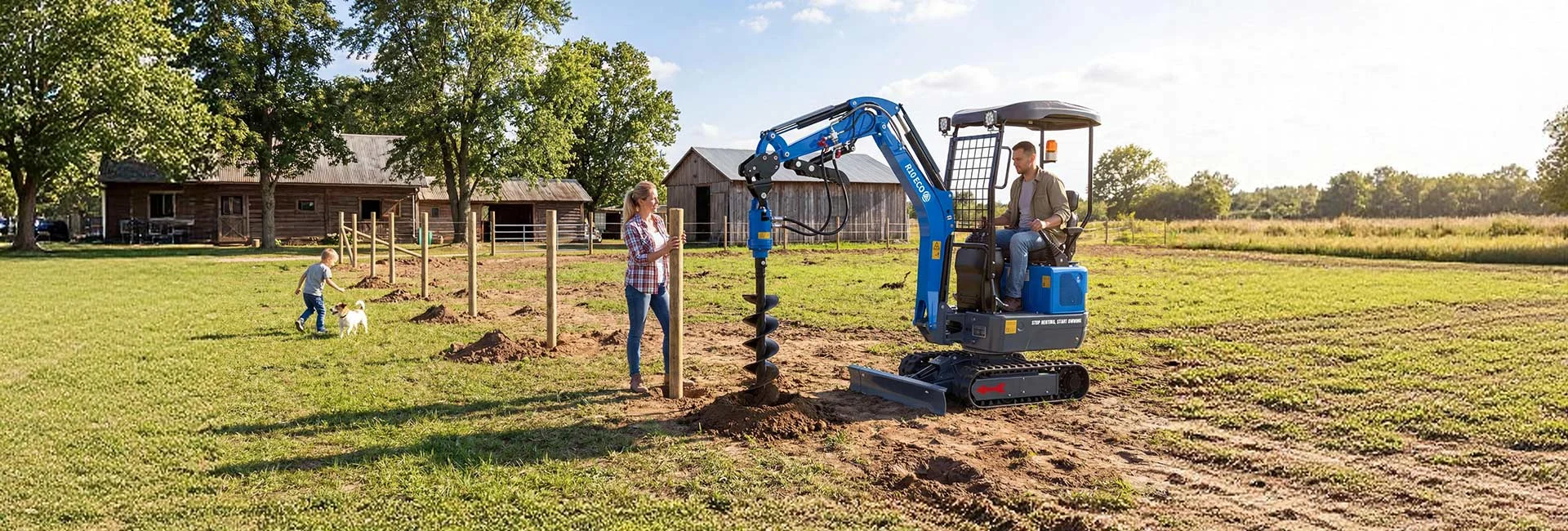
Mark the trench line with stakes and string
Position the machine with tracks parallel to the trench
Start at the far end and work toward the machine
Dig to full depth at the starting point, then move back
Maintain consistent depth and slope (1‑2% for drainage)
Stockpile spoil on one side, leaving room to work
Depth control: Use the boom and arm together for precise depth. Check frequently with a tape measure or laser level. For drainage, maintain 1‑2% slope (1‑2 inches drop per 10 feet).
| Mistake | Why It Happens | How to Avoid |
|---|---|---|
| Digging too deep too fast | Trying to take too much material | Take 4‑6 inch bites, not full bucket depth |
| Forgetting to look behind | Focused on bucket | Make a habit: look back before every swing |
| Working on uneven ground | Machine feels unstable | Use blade to level the machine first |
| Gripping joysticks too tight | Nervousness | Relax – pilot controls are sensitive |
| Ignoring the seatbelt | “Just moving a little” | Always wear it – ROPS only works if you’re inside |
Pro tip: Practice each function separately before combining them. First, master moving and turning. Then practice raising and lowering the boom. Then add bucket curl. Then put it all together.
The “Golden Rules” of excavator safety:
Always wear your seatbelt – the ROPS only protects you if you’re inside it
Never exceed the machine’s capacity – know your lift limits
Stay clear of overhead power lines – minimum 10 ft distance
Keep bystanders away – no one within the swing radius
Never leave the machine running unattended – lower attachments, set brake, remove key
Use spotters when backing – especially near obstacles or people
Check your swing path – look behind before swinging
Operate on stable ground – avoid steep slopes and soft edges
Take breaks – fatigue causes mistakes
Q: How long does it take to become proficient?
A: Basic competency takes 2‑4 hours. Proficiency for complex tasks (fine grading, working near obstacles) takes 20‑40 hours of practice.
Q: Do I need a license to operate a mini excavator on my own property?
A: No. For personal use on your land, no license is required. Commercial work may have different rules – check local regulations.
Q: What’s the hardest part for beginners?
A: Coordinating multiple controls simultaneously (e.g., swinging while lowering the boom). Practice each function separately before combining.
Q: Can I use attachments as a beginner?
A: Yes. Start with a standard bucket. Once comfortable, add a grading blade or thumb. Use the quick coupler to change attachments – it takes 30 seconds from the cab.
Q: What should I do if the machine starts to tip?
A: Do not jump out. Stay belted, lean uphill, and do not try to exit until the machine settles. Tipping is rare on level ground – avoid steep slopes.

Operating a mini excavator is a skill anyone can learn with practice and patience. Start slowly, focus on safety, and build your skills progressively. Within a few weekends, you will be tackling projects you never thought possible. RIPPA machines are designed with beginners in mind – intuitive controls, safety features, and excellent visibility make learning easier. Watch the beginner video series before your first operation, then practice in an open area for 2‑4 hours. You will be surprised how quickly you learn.
Next step: Watch operator training videos, practice in an open area, and always perform a daily inspection. You will be surprised how quickly you become proficient.


 Home
Home
 Products
 Email
Email
 WhatsApp