
Kov 16, 2026
| Your Primary Projects | Rekomenduojamas dydis | Why |
|---|---|---|
| Gardening, small trenches, planting | 1.0–1.5 tons | Fits through gates, low ground pressure, easy transport |
| Driveway repair, medium landscaping, tree planting | 1.5–2.5 tons | Balance of power and maneuverability, most popular size |
| Stump removal, pond digging, deep drainage | 2.5–4.0 tons | Enough digging force for tough jobs, still transportable |
| Commercial construction, large foundations | 4.0+ tons | Production capability, requires commercial transport |
Key insight: 85% of homeowners can accomplish everything they need with a 1.5–2.5 ton machine. Larger isn’t always better—oversized machines cause unnecessary lawn damage and transport headaches .
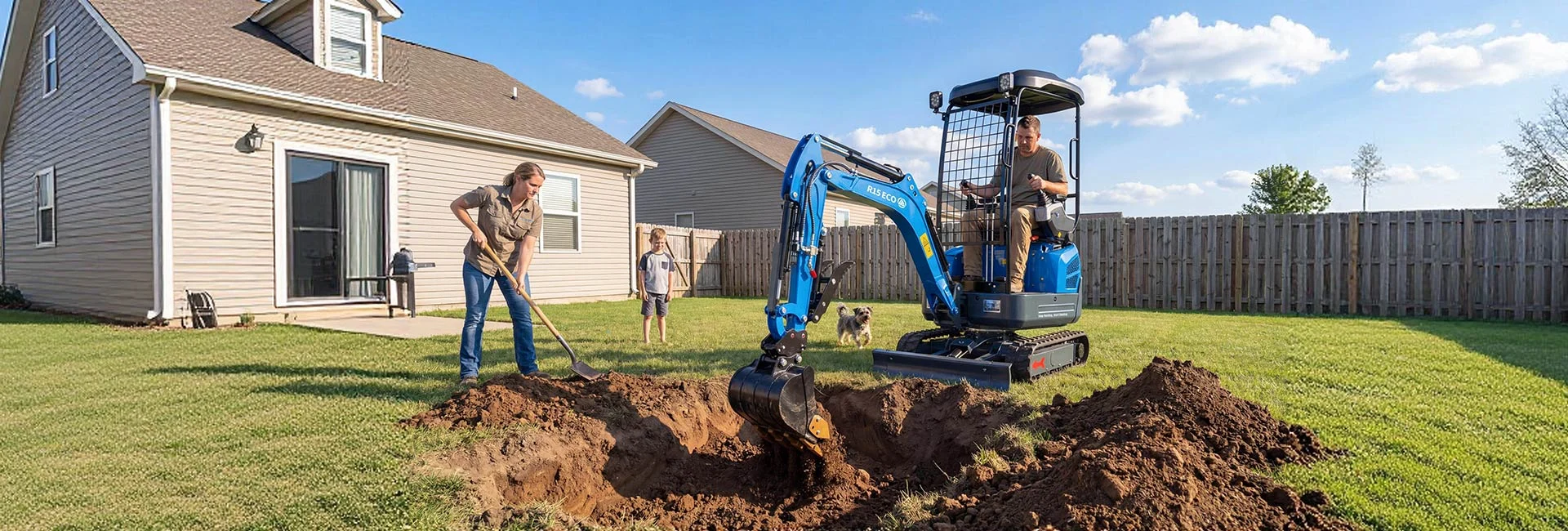
Micro Excavators (1.0–1.5 tons)
Typical models: RIPPA R10/R13, Kubota U10, Yanmar SV17
Specifications:
Digging force: 9–11 kN
Max digging depth: 7–8 feet
Lifting capacity: 200–400 lbs
Transport width: 35–40 inches (fits through standard gates)
Trailer needed: Single-axle, 3,500 lb capacity
Truck needed: Half-ton pickup
What they can do:
Garden bed preparation
Small trenches for irrigation
Planting trees and shrubs
Moving soil and mulch
Light demolition of small structures
What they can’t do:
Remove large stumps
Excavate swimming pools
Handle heavy clay soil efficiently
Break concrete or rock
Best for: Suburban homeowners, landscaping contractors, indoor work
Compact Excavators (1.5–2.5 tons)
Typical models: RIPPA R15/R18, Bobcat E35, Caterpillar 303.5 CR
Specifications:
Digging force: 11–16 kN
Max digging depth: 8–10 feet
Lifting capacity: 600–1,000 lbs
Transport width: 38–48 inches
Trailer needed: Tandem-axle, 7,000 lb capacity
Truck needed: Half-ton or 3/4-ton
What they can do:
Gravel driveway repair and regrading
Medium-depth trenching for drainage
Remove small-to-medium stumps (up to 12″)
Handle 80% of residential projects
Excavate small ponds (up to 12 ft diameter)
What they can’t do:
Excavate full-size swimming pools
Remove large stumps (over 24″)
Commercial production work
Best for: Homeowners with acreage, small contractors, rental fleets
Midi Excavators (2.5–4.0 tons)
Typical models: RIPPA R22/R32, Kubota KX71, Develon DX35Z
Specifications:
Digging force: 16–23 kN
Max digging depth: 10–12 feet
Lifting capacity: 1,200–2,000 lbs
Transport width: 51–60 inches
Trailer needed: Heavy-duty tandem, 10,000+ lb capacity
Truck needed: 3/4-ton or 1-ton
What they can do:
Remove large stumps (up to 24″)
Excavate swimming pools
Dig deep drainage trenches
Excavate building foundations
Handle major landscaping projects
What they can’t do:
Load highway trucks (dump height limited)
Commercial production work (daily use)
Best for: Large property owners, farmers, serious DIY builders
Commercial Excavators (4.0+ tons)
Typical models: RIPPA R57, Caterpillar 308 CR, John Deere 50G
Specifications:
Digging force: 23–45 kN
Max digging depth: 12–15 feet
Lifting capacity: 2,000–4,000 lbs
Transport width: 72–96 inches
Trailer needed: Commercial low-boy, CDL may be required
Truck needed: Medium-duty commercial
What they can do:
Full commercial production
Load trucks (4.8m dump height)
Run heavy attachments continuously
Handle major excavation projects
Excavate basements
Best for: Contractors, developers, rental companies
Landscaping and Gardening
| Projektas | Rekomenduojamas dydis | Why |
|---|---|---|
| Flower beds, small trenches | 1.0–1.5 tons | Minimal lawn damage, fits tight spaces |
| Tree planting (up to 10 trees) | 1.5–2.5 tons with auger | Faster hole digging, enough power for roots |
| Large grading projects | 1.5–2.5 tons with blade | Balances speed and precision |
| Terracing, retaining walls | 2.5–4.0 tons | Need reach and power for material placement |
Driveway and Hardscape
| Projektas | Rekomenduojamas dydis | Why |
|---|---|---|
| Gravel driveway maintenance | 1.5–2.5 tons | Enough weight to cut and grade, not too heavy to transport |
| Paver/base preparation | 1.5–2.5 tons | Fine control needed for final grade |
| Asphalt patching | 1.5–2.5 tons | Precision matters more than power |
| Full driveway replacement | 2.5–4.0 tons | Need power to remove old material |
Tree and Stump Work
| Projektas | Rekomenduojamas dydis | Why |
|---|---|---|
| Small stumps (under 12″) | 1.5–2.5 tons | 10–15 kN force sufficient |
| Medium stumps (12–24″) | 2.5–4.0 tons | 15–22 kN force needed |
| Large stumps (24″+), land clearing | 4.0+ tons | Maximum force and hydraulic flow |
| Tree planting (multiple) | 1.5–2.5 tons with auger | Speed and consistency |
Major Excavation
| Projektas | Rekomenduojamas dydis | Why |
|---|---|---|
| Small pond (under 15′ diameter) | 2.5–4.0 tons | 9–10 ft depth sufficient |
| Baseinas | 2.5–4.0 tons | 9–10 ft depth, need precision |
| Building foundation | 2.5–4.0 tons (house), 4.0+ tons (commercial) | Depth requirements vary by frost line |
| Full basement | 4.0+ tons | 8+ ft depth requires larger machine |
| Drainage system (large property) | 2.5–4.0 tons | Need depth and reach |
Transport Width and Gate Access
Standard residential gates are 36 inches (914 mm). If you need backyard access:
| Machine | Minimum Width | Fits 36″ Gate? |
|---|---|---|
| RIPPA R10 | 900 mm (35.4″) | Taip |
| RIPPA R13 | 950 mm (37.4″) | Tight squeeze (remove hinges) |
| RIPPA R15 | 980 mm (38.6″) | No (remove fence panel) |
| RIPPA R18 | 1,100 mm (43.3″) | Ne |
| RIPPA R22 | 1,300 mm (51.2″) | Ne |
| Kubota U17 | 980 mm (38.6″) | Ne |
| Bobcat E35 | 990 mm (39.0″) | Ne |
| Caterpillar 303.5 CR | 1,000 mm (39.4″) | Ne |
If you can’t fit through gates: Consider keeping machine on property permanently or removing fence panels. Some owners create a permanent access path.
Transport Weight
| Machine Class | Mašinos svoris | Trailer Needed | Truck Needed |
|---|---|---|---|
| 1.0–1.5 tons | 2,200–3,300 lbs | Single-axle (3,500 lb) | Half-ton pickup |
| 1.5–2.5 tons | 3,300–5,500 lbs | Tandem-axle (7,000 lb) | Half-ton or 3/4-ton |
| 2.5–4.0 tons | 5,500–8,800 lbs | Sunkusis tandemas (10 000+ lb) | 3/4-ton or 1-ton |
| 4.0+ tons | 8,800+ lbs | Commercial low-boy | Medium-duty truck |
Trailer cost considerations:
Single-axle trailer: $1,500–$3,000
Tandem-axle trailer: $3,000–$6,000
Heavy-duty tandem: $6,000–$12,000
Commercial low-boy: $12,000–$25,000
Spaudimas į gruntą
| Mašinos matmenys | Typical Ground Pressure | Lawn Damage Risk |
|---|---|---|
| 1.0–1.5 tons | 3–4 psi | Low (with care) |
| 1.5–2.5 tons | 4–6 psi | Moderate on soft ground |
| 2.5–4.0 tons | 6–8 psi | High—avoid wet lawns |
| 4.0+ tons | 8–10 psi | Severe—stay on established surfaces |
RIPPA advantage: Telescopic tracks on R13/R15/R18/R22 allow wider stance for stability while working, narrower for transport. This reduces ground pressure by 20–30% when tracks are extended .
Digging Force by Size Class :
| Size Class | Typical Dig Force | Can Dig Through |
|---|---|---|
| 1.0–1.5 tons | 9–11 kN | Palaidi dirvožemis, gėlynai |
| 1.5–2.5 tons | 11–16 kN | Sutankintas dirvožemis, smulkios šaknys |
| 2.5–4.0 tons | 16–23 kN | Hard clay, medium stumps |
| 4.0+ tons | 23–45 kN | Akmenys, dideli kelmai, griovimas |
Reach and Depth:
| Size Class | Typical Dig Depth | Typical Reach |
|---|---|---|
| 1.0–1.5 tons | 7–8 ft | 12–14 ft |
| 1.5–2.5 tons | 8–10 ft | 14–17 ft |
| 2.5–4.0 tons | 10–12 ft | 17–20 ft |
| 4.0+ tons | 12–15 ft | 20–24 ft |
Rule of thumb: For comfortable digging, your machine’s maximum depth should exceed your required depth by at least 6 inches.
Auxiliary Hydraulic Flow:
| Size Class | Standard Flow | High-Flow Option | Can Power |
|---|---|---|---|
| 1.0–1.5 tons | 10–15 GPM | Not available | Small augers, light thumbs |
| 1.5–2.5 tons | 15–20 GPM | 20–25 GPM | Medium augers, grapples |
| 2.5–4.0 tons | 20–25 GPM | 25–30 GPM | Large augers, breakers |
| 4.0+ tons | 25–35 GPM | 35–45 GPM | Forestry mulchers, hammers |
1.0–1.5 Ton Owners
“I bought an R13 for my suburban quarter-acre lot. It fits through my side gate, I can haul it with my F-150, and it does everything I need—gardening, small trenches, planting trees. I’ve never wished for a bigger machine because I couldn’t get it where I need to work.” — Mark, Ohio
1.5–2.5 Ton Owners
“My R15 is the sweet spot. I’ve done driveway repairs, dug a small pond, removed stumps, and graded a patio site. It’s powerful enough for real work but still fits in my garage. If I only had one machine, this would be it.” — Tom, Colorado
2.5–4.0 Ton Owners
“I went with an R22 because I had a pool to dig. It paid for itself on that one project. Yes, it’s heavier to transport, but when you need the power, nothing smaller will do. I’ve also cleared land, dug foundations, and removed massive stumps.” — Robert, Texas
4.0+ Ton Owners
“My R57 is a commercial machine. I use it for foundations and site work. It’s not something I’d recommend for a homeowner—transport is a production, and it’s overkill for most residential jobs. But for my contracting business, it’s perfect.” — Dave, Wisconsin
Mistake #1: Buying Too Big
Symptoms:
Can’t fit through gates
Need bigger trailer (unexpected cost)
Damage lawn and landscape
Intimidated to operate
Limited access to work areas
Solution: Start smaller than you think. You can always rent a larger machine for one-off big projects.
Mistake #2: Buying Too Small
Symptoms:
Machine struggles with toughest tasks
Slow progress on major projects
Excessive wear from working at limit
Need to rent larger machine anyway
Solution: Identify your hardest project first, then size for that—not your most common tasks.
Mistake #3: Ignoring Transport
Symptoms:
Surprise truck/trailer costs ($5,000–$15,000)
Can’t move machine between properties
Limited to one location
Solution: Calculate total transport weight (machine + trailer) and verify your truck’s capacity before buying.
Mistake #4: Overlooking Operator Experience
Symptoms:
Nervous operation
Slow progress
Potential safety issues
Damage to machine or property
Solution: Beginners should start with 1.0–1.5 ton machines. The learning curve is gentler, and mistakes are less costly.
Mistake #5: Forgetting Attachments
Symptoms:
Machine lacks auxiliary hydraulics for needed tools
Can’t use thumb, grapple, or breaker
Limited versatility
Solution: Verify auxiliary hydraulics are standard or optional before buying.
| Property Size | Rekomenduojamas dydis | Rationale |
|---|---|---|
| Under 1 acre | 1.0–1.5 tons | Can access all areas, minimal storage impact |
| 1–3 acres | 1.5–2.5 tons | Balance of power and maneuverability |
| 3–10 acres | 2.5–4.0 tons | Need power for larger projects |
| 10+ acres | 4.0+ tons or multiple machines | Commercial-scale work possible |
Special cases:
Wooded properties: Add 0.5–1.0 ton for stump removal capability. R18 or R22 recommended.
Wet/soft ground: Add 0.5 ton for stability, consider wider tracks. R15 or larger with wide track option.
Steep slopes: Add 0.5–1.0 ton for stability, avoid going too light. R18 or larger with low center of gravity.
Gated communities: Must fit through standard gate (36″). R10 or R13 only options.
| Modelis | Weight | Dig Force | Dig Depth | Min Width | Best For |
|---|---|---|---|---|---|
| R10 | 1.0 t | 9,2 kN | 7.1 ft | 35.4″ | Gardening, gates, beginners |
| R13 | 1.3 t | 10.2 kN | 7.9 ft | 37.4″ | Narrow spaces, zero tail swing |
| R15 | 1.5 t | 10.4 kN | 8.2 ft | 38.6″ | Driveways, universal homeowner |
| R18 | 1.8 t | 15.8 kN | 9.5 ft | 43.3″ | Stumps, heavy clearing |
| R22 | 2.2 t | 22.5 kN | 9.5 ft | 51.2″ | Pools, foundations |
| R32 | 3.2 t | 28.5 kN | 10.8 ft | 59.1″ | Farms, large properties |
| R57 | 5.7 t | 45 kN | 13.5 ft | Fixed | Commercial, development |
All models feature: Kubota engines, robotic-welded frames, 200-hour factory testing, and 5-year/5,000-hour warranty .
Q: Can I use a 1.5-ton machine for stump removal?
A: Yes, for small stumps (under 12″). For larger stumps, you need 2.5–4.0 tons. The R18 (1.8-ton) is specifically designed as the “Stump Buster” with 15.8 kN force.
Q: What’s the smallest machine that can dig a pool?
A: 2.5-ton class (R22 or larger). You need at least 9 ft digging depth for a standard 4–6 ft pool.
Q: Will a 1-ton machine damage my lawn?
A: With care, minimal. Ground pressure is 3–4 psi—similar to a person’s foot. Avoid operating on wet grass and use plywood mats if needed.
Q: How do I know if my truck can tow the machine?
A: Check your owner’s manual for towing capacity. Subtract trailer weight (1,500–3,000 lbs) from capacity to get allowable machine weight.
Q: What size machine do contractors use?
A: Most rental yards stock 1.5–2.5 ton machines for general work. For heavy commercial, 4.0+ tons is typical.
Q: Is bigger always better?
A: No. Bigger machines cost more, transport harder, cause more lawn damage, and may not access your work areas. Buy for your specific needs, not for bragging rights.
The right mini excavator size balances three factors: your hardest projects, your access limitations, and your transport capacity. For most homeowners with 1–5 acres, a 1.5–2.5 ton machine (like RIPPA’s R15 or R18) offers the best combination of capability and practicality.
Remember: you can always rent a larger machine for occasional big projects. But you’ll use your own machine for dozens of smaller tasks—so optimize for those, not the one-time giant project.
Still unsure which size fits your property? Use our interactive Size Finder tool or contact a local dealer for a site consultation. Most will visit your property, review your project list, and recommend the perfect machine—often at no charge.


 Pagrindinis
 Produktai
 El. paštas
 "WhatsApp"