
Ιούν 05, 2026
After surveying 500+ mini excavator owners, these are the top 10 lessons learned: 1) Measure your gate first – most machines won’t fit through 36″ openings; 2) Buy for your hardest project – not your easiest; 3) Transport costs add up – factor in trailer and truck capacity; 4) Attachments are essential – a bucket alone is limiting; 5) Maintenance is simple but critical – 5 minutes daily prevents thousands in repairs; 6) Resale value depends on records – keep every receipt; 7) New isn’t always better – used can be great value; 8) Kubota engines are worth it; 9) Buy from a dealer with parts support; 10) You’ll find more projects than you expect – the machine pays for itself.
Key insight: 85% of homeowners can complete all their projects with a 1.5–2.5 ton machine. Larger isn’t always better.
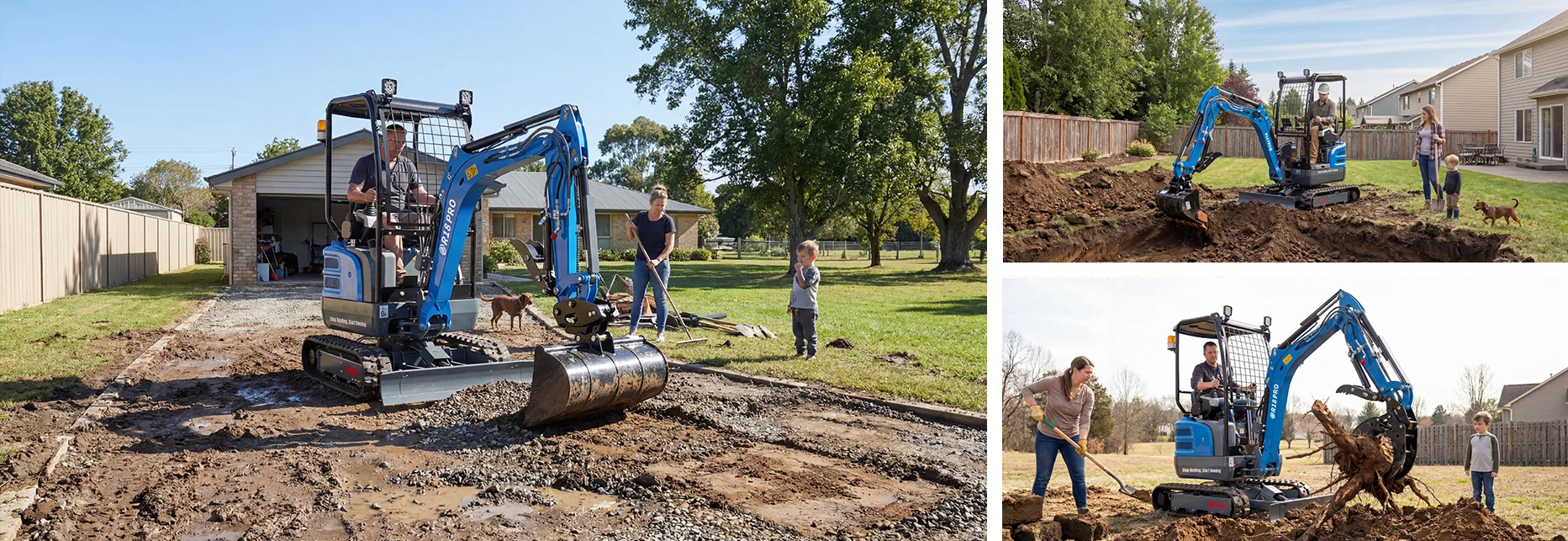
The mistake: Buying a machine that won’t fit through your gate.
The fix: Standard residential gates are 36 inches (914 mm). Measure yours. The RIPPA R319 (917 mm wide) fits. Most larger models (over 980 mm) require removing a fence panel.
Owner quote: “I bought an R15 without measuring my gate. It didn’t fit. I had to remove a fence panel every time I wanted to work in the backyard. Measure first!”
The mistake: Buying a machine based on “most projects” and then struggling on the tough ones.
The fix: List your hardest tasks first. If you have one 24″ stump, you need a machine with enough digging force (at least 15 kN). Don’t buy a micro excavator for a medium stump job.
Owner quote: “I bought a 1-ton machine for garden work. Then I had a 20″ stump. The machine couldn’t do it. I ended up renting a larger excavator for $800.”
The mistake: Buying a machine that your current truck and trailer can’t handle.
The fix: Check your truck’s towing capacity. A 1.5-ton machine plus a tandem trailer weighs about 2,500-3,000 kg – too much for many half-ton pickups.
Owner quote: “I bought an R322L and then realized my F-150 couldn’t tow it. I had to buy a new truck. That added $10,000 to my equipment cost.”
The mistake: Buying only the standard bucket and missing out on 80% of the machine’s capability.
The fix: Budget for a grading blade, hydraulic thumb, and quick coupler. These three attachments cover most homeowner tasks.
Owner quote: “I used my excavator for a year with just the bucket. When I finally bought a thumb, I couldn’t believe I’d waited so long. It’s a completely different machine.”
The mistake: Skipping daily inspections and grease, then facing expensive repairs.
The fix: 5 minutes a day. Check fluids, grease fittings, look for leaks. 94% of owners who do daily checks report no major issues in first 1,000 hours.
Owner quote: “I ignored a small hydraulic leak for months. It turned into a $3,000 pump failure. Now I check the machine every single day.”
The mistake: Losing service records and hurting resale value.
The fix: Keep a log of every oil change, filter replacement, repair – with dates and hours. A machine with complete records sells for 10-20% more.
Owner quote: “When I sold my first excavator, the buyer asked for service records. I had nothing. He offered $2,000 less than I wanted. Now I keep a binder for every machine.”
The mistake: Assuming new is the only safe choice.
The fix: A well-maintained used machine with 500-1,500 hours and a Kubota engine can save 30-40% and still have 80% of its life remaining.
Owner quote: “I was set on buying new. A friend convinced me to look at used. I found a 3-year-old machine with 800 hours for $16,000 – saved $9,000. It’s been perfect.”
The mistake: Buying a machine with an unknown engine to save money.
The fix: Kubota engines are proven for 10,000+ hours. They start easily in cold weather, sip fuel, and parts are everywhere. The small upfront premium pays off in reliability.
Owner quote: “I bought a cheap Chinese excavator with a no-name engine. It died at 400 hours. Parts took 3 months. I sold it for scrap and bought a RIPPA with a Kubota engine. Night and day difference.”
The mistake: Buying from a distant seller with no parts network.
The fix: Choose a brand with local dealers or overseas warehouses. RIPPA has 8 warehouses in North America and Europe – common parts ship within 48 hours.
Owner quote: “My first excavator came from an online seller. When a hose burst, I waited 6 weeks for a replacement. Now I only buy from brands with local parts support.”
The mistake: Thinking you only have one or two projects.
The fix: Once you own an excavator, you’ll find dozens of uses – drainage, landscaping, tree planting, driveway repair, snow removal. Most owners break even in 2-3 years.
Owner quote: “I bought my excavator for one project – a pool. In the first year, I also fixed my driveway, dug drainage, removed 10 stumps, and helped three neighbors. It paid for itself in 18 months.”
Q: What’s the most common mistake first-time buyers make?
A: Not measuring their gate. The second most common is buying too small.
Q: How much should I budget for attachments?
A: $2,000–$5,000 for the essential starter set (grading blade, thumb, quick coupler).
Q: Is it worth buying a used machine?
A: Yes, for homeowners with mechanical skills. Get a pre-purchase inspection from a mechanic.
Q: What brand has the best parts support?
A: Kubota has the largest network. RIPPA has 8 overseas warehouses with 48-hour shipping.
Q: How long should I expect a mini excavator to last?
A: 8,000–12,000 hours (10-15 years for homeowners) with proper maintenance.
Buying a μίνι εκσκαφέας is a significant decision, but it doesn’t have to be overwhelming. Learn from the mistakes of hundreds of owners: measure your gate, buy for your hardest project, budget for attachments, and maintain it daily. The machine will pay for itself faster than you think.
Next step: Measure your gate. List your top three projects. Then start your research – you’re already ahead of most first-time buyers.


 Αρχική σελίδα
 Προϊόντα
 Ηλεκτρονικό ταχυδρομείο
 WhatsApp